
Communicating with someone with dementia usually gets easier when you slow down, keep sentences short and give the person time to answer. Eye contact, a warm tone of voice and gentle gestures often carry more meaning than the words themselves. This guide covers how dementia changes conversation, what to try at home, what to avoid, and how to stay connected when talking becomes hard.
How dementia changes communication
Dementia affects more than memory. Over time it changes how a person finds words, follows a conversation and makes sense of what they hear. The NHS explains that responses can become slower, and that carers often end up starting conversations rather than waiting for them.
Dementia UK lists some of the changes you might notice:
- difficulty finding the right word, or using the wrong one
- muddling words or sounds
- losing track of a conversation, especially in a noisy room
- finding humour or sarcasm hard to follow
- repeating questions or stories
- good days and bad days, often linked to tiredness or feeling unwell
Dementia UK also points out that a person with dementia can often understand far more than they can say. So keep including them, even when their replies are short.
Before you start: set up the conversation
Small preparations make a real difference. Before you say anything important, try to:
- Get their attention. Stop what you are doing, say their name and make eye contact.
- Get on the same level. If they are sitting, sit down too. The NHS suggests keeping a respectful distance so you do not feel imposing.
- Reduce background noise. Turn the television or radio down, but check with them first.
- Check glasses and hearing aids. Dementia UK notes that hearing loss is common alongside dementia. Ask the GP about a hearing check if you are unsure.
- Pick a good moment. Many people find conversation easier when they are rested, not when they are hungry, tired or in the middle of something else.
Tips for communicating with someone with dementia
Keep it short and clear
Speak clearly and a little more slowly, using short sentences. Give one piece of information at a time. Instead of "Shall we get our coats on and pop to the shop for some milk?", try "Let's put our coats on." Then, once that is done, "We're going to the shop."
Use names rather than "he" or "she". Dementia UK suggests this because pronouns can be hard to follow.
Make questions easy to answer
Open questions such as "What would you like for lunch?" can feel like a test. Simple choices are easier: "Would you like soup or a sandwich?" Showing both options at the same time helps even more. The NHS advises avoiding complicated choices and rephrasing a question if the first version does not land.
Wait for the answer
Silence can feel uncomfortable, but it gives the person time to find their words. Try not to finish their sentences or rush them. The NHS notes that people may feel pressured if you try to speed up their answers.
Show as well as tell
Dementia UK suggests using gestures to act out what you mean, such as miming drinking a cup of tea or putting on shoes. A photo of where you are going, or the actual coat in your hand, can make words easier to understand.
Listening when words are hard to find
Communication runs both ways. As a carer, you will probably find yourself listening differently. The NHS recommends active listening:
- Give your full attention and try not to interrupt.
- Watch facial expressions and body language as well as words.
- Repeat back what you think you heard and ask if that is right.
- Acknowledge what they said, even if it does not answer your question.
If they are stuck on a word, you could gently offer a guess: "Do you mean your cardigan?" Often the feeling behind the words matters more than the facts. If your mum says she needs to get home to the children, she may be feeling anxious or wanting to be useful. Responding to that feeling usually works better than explaining that her children are grown up.
What to avoid
Some habits are very natural but tend to make conversations harder:
- Correcting. Pointing out mistakes can feel embarrassing and rarely changes anything.
- Testing memory. "Do you remember who this is?" can feel like an exam. Try "This is your grandson Tom" instead.
- Arguing. If they are convinced of something, a gentle change of subject usually goes further than a debate.
- Talking over them. The NHS advises letting the person speak for themselves, including in discussions about their own health and care.
- Patronising. Simple language is not the same as baby talk. Speak to them as the adult they are.
When words are no longer enough
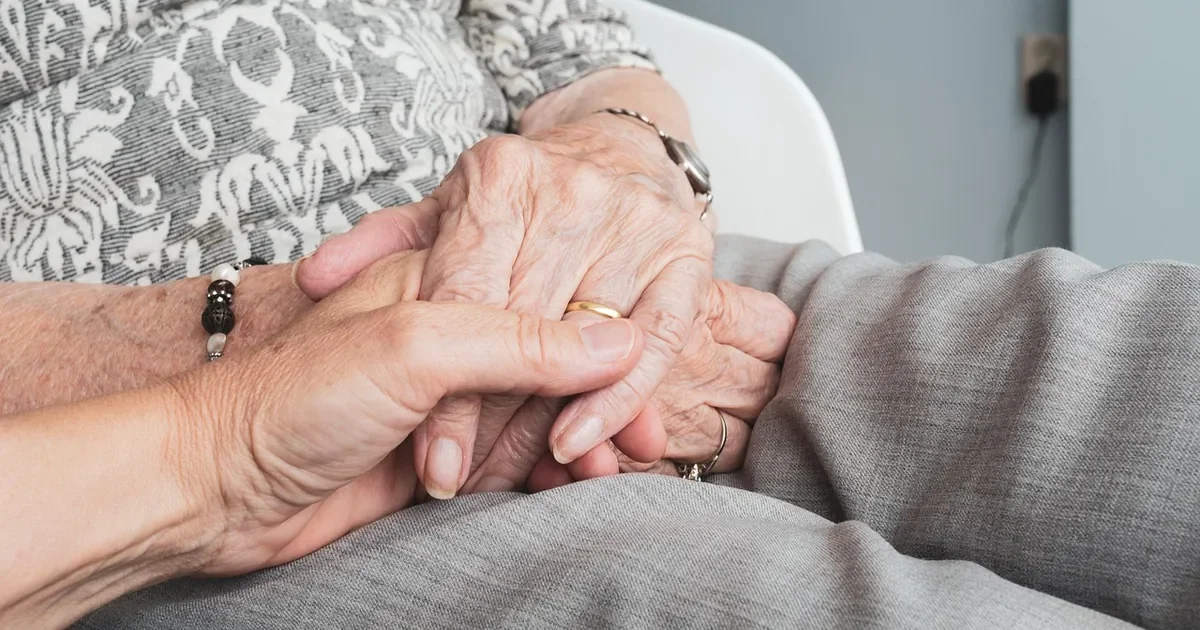
As dementia progresses, body language and touch become more important. The NHS describes how holding a hand or a reassuring pat on the arm can help, as long as you watch for signs that the person is comfortable with it.
Your own body language matters too. People with dementia often pick up on tension, so a smile and a relaxed posture can say more than "everything's fine" said through gritted teeth.
Shared moments can replace conversation: listening to a favourite song, looking through a photo album, folding towels together or simply sitting side by side. Our guides to music for dementia and activities for people with dementia at home have ideas for this.
Handling difficult moments
There will be times when a conversation turns into frustration, anger or upset. In those moments:
- Stay as calm as you can and lower your voice.
- Check for simple causes such as hunger, thirst, pain, needing the toilet or feeling too hot or cold.
- Acknowledge the feeling: "You seem worried. I'm here."
- Give space if needed, then try again later.
If the person seems more confused than usual, Dementia UK advises contacting their GP, as there may be another cause such as an infection or dehydration. For situations where help is refused, see our guide on how to respond when a person with dementia resists care. Late afternoon restlessness is covered in our article on sundowning.
Watching together with Menta
Menta is a streaming platform made for people living with dementia. Its videos move at a calm pace, without sudden cuts or loud noises. Watching nature, animals or familiar scenes side by side can be a gentle starting point for a few shared words, or simply for being together. You can read more about the thinking behind it on our why Menta page.
In short
- Get their attention first: name, eye contact, same level
- Use short sentences with one idea at a time
- Offer simple choices and give plenty of time to answer
- Do not correct, test or argue; respond to the feeling
- Use gestures, pictures and touch when words are hard
Support for you as a carer
Changing the way you communicate takes patience, and nobody gets it right every time. Dementia UK runs a free Dementia Helpline where you can talk things through with a specialist dementia nurse. You could also ask the GP whether a referral to a speech and language therapist might help. Talking to other carers, in person or online, can be a good way to share what works.

